How can you use AI in HR?
AI in HR: How to Transform Human Resources in 2025
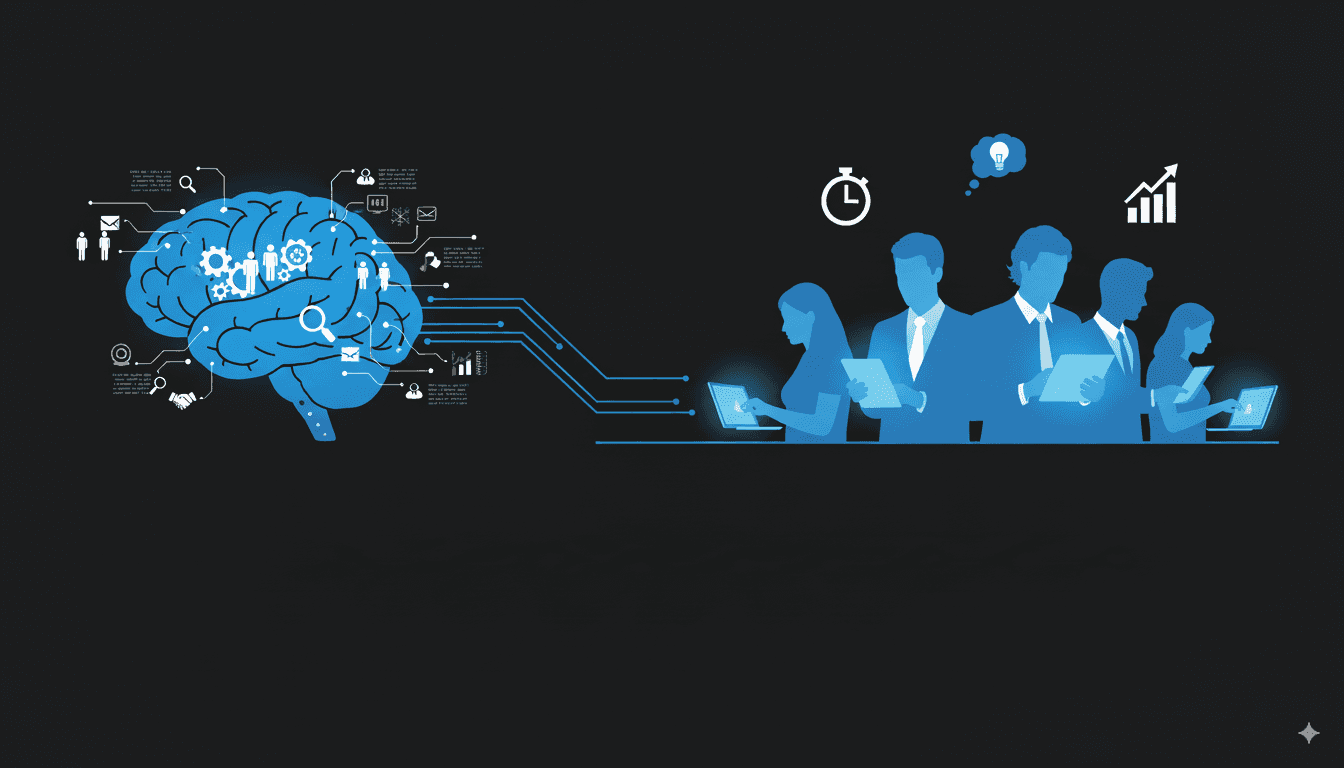
AI is rapidly becoming a crucial part of modern HR work. From recruitment to employee development – artificial intelligence is transforming how companies work with their most important asset: their employees. By automating time-consuming tasks, analyzing complex data sets, and supporting strategic decision-making, AI can help HR departments both save time and dramatically improve the quality of their processes.
But how do you concretely use AI in HR? In this guide, we go through the four key areas where AI makes the biggest difference and provide you with practical examples of how your HR department can get started today.
1. AI for Recruitment: Find the Right Talent Faster
Recruitment is perhaps the area within HR where AI has made the most significant impact. Traditional recruitment is notoriously time-consuming – HR departments can receive hundreds, sometimes thousands of applications for a single position. Manually going through every CV and cover letter is not only inefficient, but it also increases the risk of missing the right candidate or letting unconscious biases influence the selection.
How AI-Driven Recruitment Works
Automatic CV Screening
AI systems can analyze hundreds of CVs in seconds and identify the candidates that best match the job requirements. By using natural language processing (NLP), AI can understand the context of a candidate’s experiences, not just look for exact keywords. This means that the tool can identify transferable skills and see potential that may not be obvious at first glance.
Objective Assessment
One of the biggest advantages of AI in recruitment is the ability to reduce unconscious biases. Humans are inadvertently influenced by factors such as name, age, gender, or educational background. AI systems can be programmed to focus solely on relevant qualifications and experience, creating a fairer recruitment process.
Interview Analysis
Modern AI tools can also analyze video interviews and assess candidates' responses, tone of voice, and communication skills. Some systems can even conduct preliminary interviews via chatbot, asking standard questions and summarizing responses for the HR team.
Practical Tools to Test
For Swedish companies, there are several powerful AI recruitment tools:
HireVue: Video interviewing platform with AI analysis
Pymetrics: Game-based assessment that matches candidates to roles
Greenhouse with AI: Applicant tracking system (ATS) with built-in AI
LinkedIn Recruiter: AI-driven talent search and matching
Results You Can Expect
Companies that have implemented AI in recruitment report:
75% reduction in time for initial CV screening
40% faster time-to-hire (time from ad to employment)
35% improvement in the quality of shortlist candidates
Significantly more objective selection process
Important to Remember: AI should complement, not replace, human judgment. The final decision to hire someone should always be made by humans who can assess cultural fit and soft values.
2. Employee Development and Learning: Tailored Development Plans
AI is also revolutionizing how companies work with skills development and employee growth. Instead of offering the same standard training to everyone, AI can help create personal development plans based on each employee's unique needs, ambitions, and learning styles.
Skills Analysis and Gap Identification
AI tools can continuously analyze employees' skills by:
Evaluating performance in real work situations
Analyzing completed projects and tasks
Comparing current skills with future organizational needs
Identifying specific skill gaps that need addressing
Example: If the AI sees that a salesperson consistently performs well in client meetings but struggles with reporting, the system can automatically recommend specific training in CRM tools or data analysis.
Personal Learning Paths
Based on the skills analysis, AI can create customized training plans:
Suggest relevant courses, webinars, and microlearning modules
Adjust content difficulty to the employee's current level
Recommend optimal pace and timing for learning
Identify internal mentors or experts for assistance
Career Planning with AI
AI can also help employees plan their careers within the organization by:
Identifying possible career paths based on current skills
Showing what skills are needed to take the next step
Matching internal job opportunities with the employee's profile
Predicting which roles will become available in the future
Concrete Tool: Platforms like Degreed, LinkedIn Learning (with AI), and EdCast use AI to personalize learning and development.
Benefits for Both Employees and the Organization
For the Employee:
More relevant and engaging development
Clear career path and development opportunities
Feeling that the company is investing in their future
For the Company:
Higher retention (employees stay longer)
Increased productivity through the right skills
Better preparation for future skills needs
Stronger employer brand
3. Employee Experience: Measure and Improve the Work Environment
One of the most exciting applications of AI in HR is the ability to continuously measure and improve the employee experience. Traditional employee surveys are conducted perhaps once or twice a year, meaning that issues are often discovered too late.
AI-Driven Pulse Surveys
Modern AI tools enable continuous feedback through:
Smart Chatbots
AI chatbots can regularly check in with employees via Slack, Teams, or email. The questions are short, non-intrusive, and can be asked at optimal times. Example: "On a scale of 1-10, how engaged do you feel in your work this week?"
Sentiment Analysis
AI can analyze texts from various sources (anonymized and GDPR-safe):
Internal communication channels
Feedback forms
Exit interviews
Team meeting notes
By analyzing language, tone, and word choice, AI can identify early warning signs of burnout, dissatisfaction, or conflicts.
Predictive Analysis
The most advanced AI systems can predict which employees are at risk of leaving based on:
Reduced activity in internal systems
Changed communication patterns
Lower engagement in pulse surveys
Historical patterns from previous resignations
Proactively Improve the Work Environment
When AI identifies issues, HR can act before the situation escalates:
Offer support calls to stressed employees
Redistribute tasks in case of overload
Identify teams with low cohesion
Detect toxic work environments early
Tools to Explore:
Culture Amp: Employee engagement platform with AI insights
Peakon (Workday): Real-time feedback and sentiment analysis
Lattice: Performance management with AI-driven insights
Microsoft Viva Insights: Analyzes work patterns in Microsoft 365
Ethical Considerations
It's important to be transparent about how AI is used to measure employee experience:
Always clarify when data is collected
Ensure feedback can be given anonymously
Never use data to punish individual employees
Strictly follow GDPR and other data protection regulations
4. Strategic Decision Making: Data-Driven HR Management
AI allows HR to transition from an administrative function to a strategic business partner through advanced data analysis and predictive modeling.
Resource Planning and Staffing
AI can analyze historical data and external factors to forecast:
Future recruitment needs based on company growth
Seasonal fluctuations in workload
The impact of new projects on staffing needs
Optimal allocation of resources between departments
Example: A retail company uses AI to analyze sales data, weather conditions, and local events to predict staffing needs in each store up to 6 weeks in advance.
Retention and Talent Management
By analyzing patterns, AI can help HR:
Identify key people who are important to retain
Understand why employees are leaving the company
Predict the risk of resignation among high-performing employees
Calculate the cost of employee turnover
Insights AI Can Provide:
"Employees in role X with 3-5 years of experience have a 35% higher risk of leaving if not promoted within 18 months. Recommendation: Implement clearer career paths for this group."
Competency Planning
AI can model future skills needs by analyzing:
The company's strategic goals
Technological trends in the industry
Current skills in the organization
External labor market and availability
This allows HR to plan long-term and start building competencies before needs become urgent.
Salary Benchmarking and Compensation
AI can analyze market data and help HR:
Set competitive salaries
Identify wage disparities that may need addressing
Predict the impact of salary increases on retention
Optimize total compensation packages
Tools for Strategic HR:
Visier: People analytics platform with AI
ChartHop: Org planning and people analytics
One Model: Data-driven people analytics
SAP SuccessFactors: HCM with AI insights
How to Get Started with AI in HR
Step 1: Identify Your Greatest Need
Do not start by trying to implement AI everywhere at once. Ask yourself:
Where are we losing the most time today?
Which area has the greatest impact on our business goals?
Where are we making the most errors or have the highest risk?
Step 2: Start Small with Pilot Projects
Choose a specific area and test:
An AI tool for CV screening in the next recruitment
A pulse measurement bot in a single team
A learning platform for a specific department
Step 3: Train Your HR Team
Ensure the team understands:
How AI works (basic understanding)
Opportunities and limitations
Ethical aspects and GDPR
How to interpret AI-generated insights
Step 4: Build Trust within the Organization
Communicate transparently about:
Why you are implementing AI
How data will be used
What benefits employees can expect
That AI complements, not replaces, human judgment
Step 5: Measure and Optimize
Set clear KPIs:
Time-to-hire (recruitment)
Employee engagement score (employee experience)
Retention rate (retention)
Learning completion rate (development)
Frequently Asked Questions About AI in HR
Will AI Replace HR Personnel?
No. AI automates administrative tasks and provides better decision support, but human empathy, judgment, and relationship building remain central to HR work. AI frees up time so HR can focus more on strategic work and genuine human relationships.
Is AI-Driven HR GDPR Compatible?
Yes, if implemented correctly. Choose tools that are designed to comply with GDPR, be transparent about data collection, and ensure personal data is handled securely. Always consult legal expertise during implementation.
How Much Does It Cost to Implement AI in HR?
It varies widely. Simpler tools like AI chatbots can cost from 2000-5000 SEK/month, while comprehensive people analytics platforms can cost 50,000+ SEK/month for larger organizations. Start small and scale up based on ROI.
How Long Does It Take to See Results?
Recruitment: 1-2 months for improved process
Learning: 3-6 months for measurable skills development
Engagement: 2-4 months for clearer insights
Strategic Analysis: 6-12 months for long-term impact
Can Small Companies Benefit from AI in HR?
Absolutely! Many AI tools have pricing plans for small businesses, and some features (like LinkedIn Recruiter AI or simple chatbots) are available at low cost. Even small improvements in efficiency can have a big impact for smaller HR teams.
Conclusion: HR's Transformation Has Just Begun
AI in HR is no longer music of the future – it’s a reality that Swedish companies are already using to be more efficient, fair, and strategic. By implementing AI in recruitment, employee development, employee experience, and strategic decision-making, HR departments can:
Save hundreds of hours on administrative tasks
Make better, more data-driven decisions
Create fairer and more objective processes
Improve employee experience and retention
Position HR as a strategic business partner
The key is to start small, test, learn, and scale up based on results. AI is a tool that enhances HR’s work – it doesn’t replace the human element that will always be central in HR work.
Next Steps: Visit Aival.se and explore our curated selection of AI tools for HR. Save your favorites and access in-depth reviews and comparisons.
Find More AI Tools for HR here: HR
Date: March 21, 2025.
Written by: aival.se
Read more:

Load more